
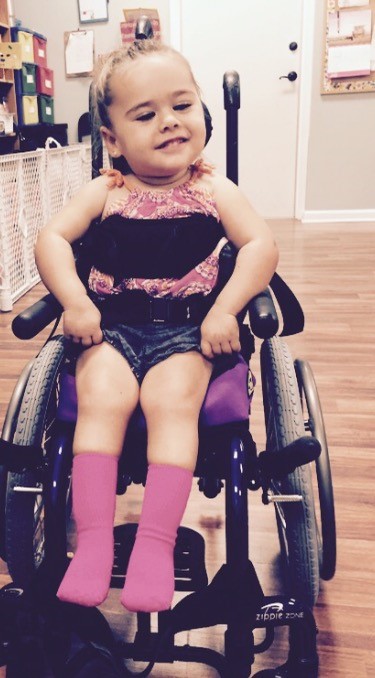
Avleigh is a very smart, confident, determined and beautiful 2 1/2 year old little girl. On her 2nd birthday she was diagnosed with Pontocerebellar Hypoplasia Type 2D. This is a very rare disorder that she will have to battle the rest of her life. It gives her limitations on both motor and communicative skills. This awful disorder is progressive and will become more aggressive as her body grows and her brain changes. It affects the development of the brain, particularly the cerebellum and the pons. In the case of PCH2, the vermis is relatively spared leading to the classic image of a dragonfly. In Avleigh’s case, she has experienced high tone, spatisity, muscle spasms, farsightedness and seizures.
Avleigh was born a full term baby and immediately seemed “different”. At the time of birth we did notice that she was very tight, but it was not mentioned to be anything alarming by the nurses or hospital staff. It felt like we were going to hurt her just with a change of clothes. Then we started noticing more signs of concern. At her 3 month checkup first thing they check and ask about is head control. When we talked about her lack of control and her tendency to hang her head to the right side, it was just noted that she was a little delayed and it was nothing to be worried about. Another 3 months go by and as all parents do with a child this young, we were just waiting for her to reach some of these milestones. Well here we were once again at her 6 month wellness and not only did she not meet her 6 month milestones but she still hadn’t met the ones for 3 months! That is when reality made my heart sink to my toes. All the little things that just seemed “different” we’re starting to become real issues. This is when we requested her to be evaluated by Louisiana’s Early Steps Prevention System.
Early Steps has really helped her in various different ways. She’s been receiving Physical Therapy and Occupational Therapy since she was 7 months old, then soon after she began Speech Therapy. Physical therapy is working on stretches, sitting, standing and mobility with the use of her gait trainer and wheelchair. Occupational therapy works on reaching and grabbing objects and weight balance. Speech therapy is working on breathe support, sounds and communication through a touch communication device. We have recently added on Vision Therapy which is working on eye gaze and eye contact. Along with these weekly therapies, we also work with her at home. She is now able to sit for short periods of time once propped, push herself in her gait trainer, turn pages in books, drink from a straw and play with a ball.
Neurology intervened in January 2015. Their first impression was that she would be diagnosed with cerebral palsy. After her first MRI the good news was that her scan was normal. The bad news was it didn’t give us any answers. From there we also tested her for seizure activity through EEG, and once again the test results were “normal”. We adventured out to Neurology at the Mayo Clinic to try to get more answers. They did a repeat MRI in January of 2016 and found the cerebellum was slightly underdeveloped only in the folds. They were a little thinner than they should be. However, the team there didn’t feel that it was anything to cause such significant developmental delays.
Orthopedic and physical medicine/rehab are also regular visits for Avleigh to treat her high tone, spasticity and motor delay. We began Botox treatments in the hips to get assistance in diaper changes and to help with the tone and spasticity. The Botox did really good for the areas we were able to treat, but due to her small size (5th percentile) those areas were very limited. We then decided to try an oral medication to help with the high tone and spasticity. She started Baclofen treatment in January 2016 and has significant improvement in mobility of her arms and hands. It also helped her gain better neck and trunk control. She became much more content with herself; able to self-sooth, sleeps all night and able to play better. Orthopedic is following her hip development very closely. Her recent x-ray has shown concern with the health of the joints. The increased tone is causing hip contracture and will result in other medical issues if not treated properly. His suggestion is to have surgery at the age 3-4 to relieve tension on the hip joint.
When neurology came up empty with a diagnosis, we began seeing genetics. They started out by doing the basic screening which didn’t show much for a diagnosis, but did uncover that she has elevated metabolic levels. With that discovery, she was diagnosed with mitochondrial dysfunction. Further genetics testing was required to confirm if she had actual mitochondrial disease. So we chose to continue the testing and did the full GeneDX testing through genetics. 6 months later we received her results and she was diagnosed with Pontocerebellar Hypoplasia Type 2, subtype D. At the time of the diagnosis, we were given very little information on the disease except that it was very important to keep her healthy. We searched all over the United States to try to find a doctor that had some experience with this diagnosis. Unfortunately, very few even heard of the disease.
Since then, she has a new geneticist, neurologist and gastroenterologist that are following her very closely. We have been suspecting that she is having silent seizures for the last few months and had her first convulsive seizure in June. She is now prescribed rescue meds for any seizures lasting longer than 3 minutes. She had a 24-hour EEG but it did not show any other seizure activity. She will continue to be monitored and repeat the EEG if our suspicions continue or worsen. In addition, gastroenterology has performed a scope which has revealed that her esophagus has inflammation. To relieve the inflammation, she has been prescribed another medication. She now has a wheelchair that helps her keep correct posture, which she absolutely loves! Even her big sister enjoys pushing her around. She is also wearing AFO’s (braces on her legs) for proper floor placement and wrist splints to train her to open her hand more, keep her thumb out and keep her wrists straight. Her new geneticist has given us a lot more information on the disorder and a plan! In this plan, she started her on mitochondrial cocktail to help functionality of her organs and selenium on a trial basis to see if it will help with her overall function. It’s only been a week on selenium and we are already seeing change! She’s moving around while on her belly. It’s kind of like a wiggle worm, but it’s movement!
In the near future we have many decisions that will need to be made. These decisions go from whether or not daycare is the right place for her, recommended surgeries, medications and even the signing of a Do Not Resuscitate Order. Although we know that she will not live a full life and the disease will continue to progress, the DNR is not something that we are comfortable with at this time. We will continue to pray and provide the best care to give her the best quality of life possible.


 Avleigh's Journey
Leave a reply to Marlene Dardar Cancel reply